
A lead fills in your form at 9:40 on a Tuesday night. Your team sees it at 11 the next morning. Somebody calls at 11:20.
Thirteen hours. Feels normal. It is normal — it is roughly what happens at most companies I talk to. It is also, quietly, where the deal went.
By 11:20 that buyer has messaged two of your competitors on WhatsApp, got a reply from one of them the same night, and has already started thinking of that vendor as "the responsive one". You are not competing on price at that point. You are competing on a first impression you already lost.
The number that should bother you
The best data on this is old but nobody has managed to make it less true. Harvard Business Review audited 1.25 million sales leads and found that companies contacting a lead within the first hour were about seven times likelier to qualify it than those who waited just one hour more, and roughly sixty times likelier than those who waited a day.
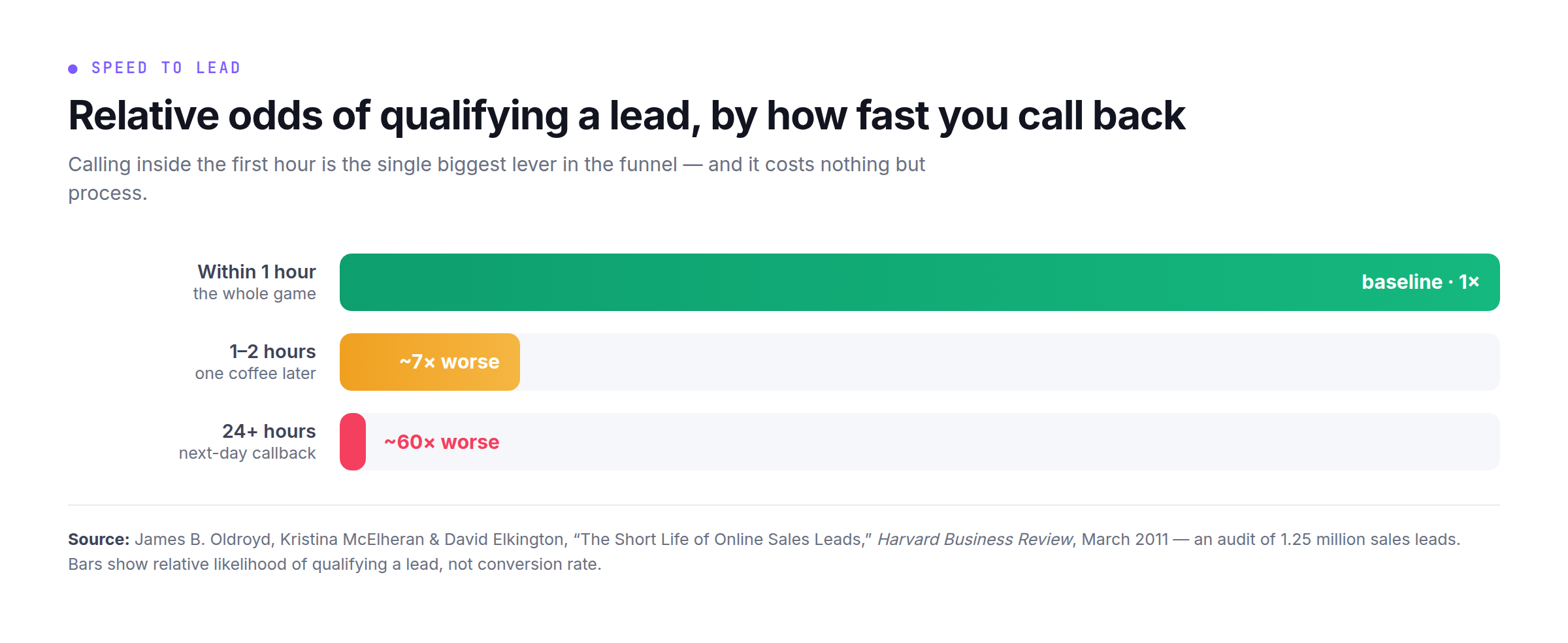
Two honest caveats. That study is from 2011, and it measures qualification, not closed revenue. But every year since, buyers have got faster and more impatient, not slower. If the 2011 number is wrong today, it is almost certainly wrong in the direction of being too generous.
Here is the part I find genuinely annoying: this is the cheapest fix in your entire funnel. You do not need better leads, a bigger team or a new pitch deck. You need to answer faster.
In India the clock runs faster still
Most speed-to-lead advice is written for a market where buyers fill a form and wait politely for an email. That is not how buying works here.
- Your buyer messages three vendors at once, on WhatsApp, and goes with whoever replies first with something useful.
- A lot of intent arrives as a missed call, at 10pm, from a number you have never seen.
- Half the conversation is Hinglish. "Saturday ke liye site visit book kiya tha, reschedule karna hai." Your English-only chatbot does not survive that sentence.
- The buyer expects a quotation, then a proper GST invoice, and gets nervous if either looks improvised.
None of this is a motivation problem. Your team is not slow because they are lazy. They are slow because you cannot reasonably staff humans against WhatsApp, phone and email, twenty-four hours a day, in two languages, while also asking them to actually sell.
So the gap has to be closed by something that does not sleep.
What we built to close it
This is the part where I am obviously biased, so treat it as a description of one approach rather than a neutral survey. Everything below is live in Autoli today and you can try most of it without talking to us.
Answer the phone. At 2am. In Hinglish.
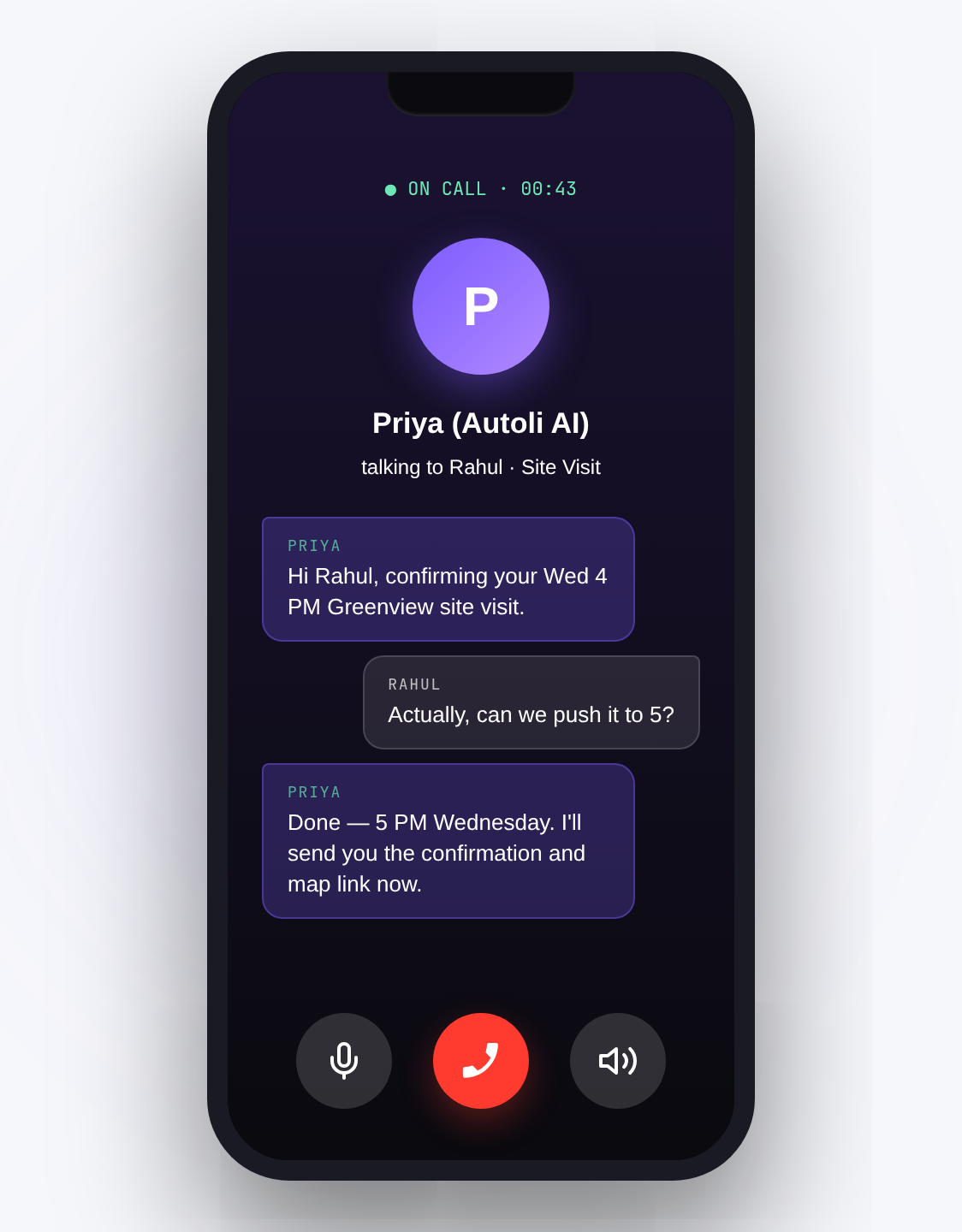
A voice agent picks up inbound calls and makes outbound ones, with sub-second latency, and it can call tools mid-conversation — so it can actually check a slot and move a site visit rather than promising someone will call back.
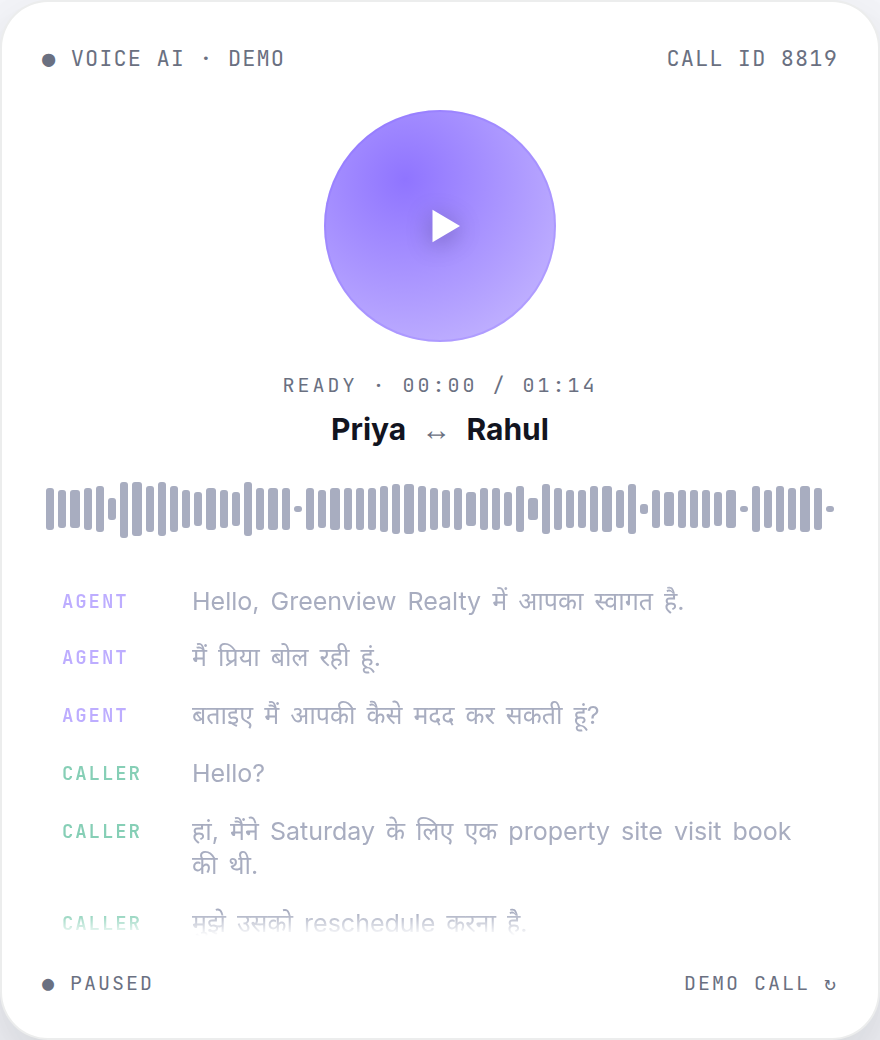
The recording, the transcript and a summary attach to the lead. That last bit matters more than the AI itself. A call your rep cannot see may as well not have happened.
If you want to hear it rather than read about it, the agent answers on +91 80353 74717. Call it. It is a real number, not a demo video.
Reply on WhatsApp, because that is where they already are
A WhatsApp agent that qualifies, answers product questions and books meetings, in Hindi, English and thirty-odd other languages.
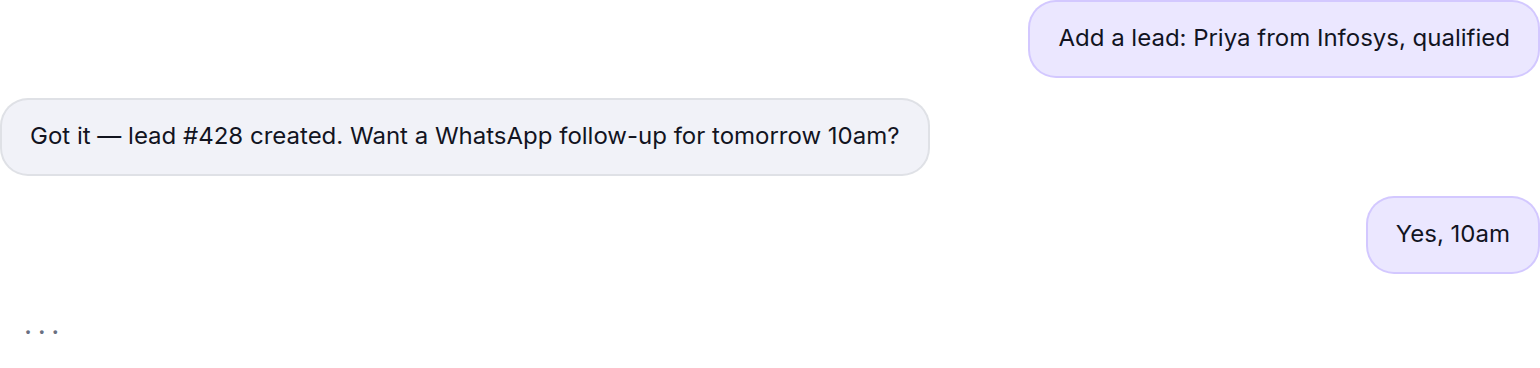
One deliberate design decision worth calling out: you connect your own WhatsApp Business number through Meta's Embedded Signup, and Meta bills you directly for conversations. The number and its history stay yours. If you ever leave us, you take them with you. We think anyone who holds your WhatsApp number hostage is telling you something about their confidence in the rest of the product.
Put every channel on the same record
The failure mode I see most often is not "we have no tools". It is four tools that each know a quarter of the story — calls in one place, WhatsApp on somebody's personal phone, email in Gmail, and the CRM last updated on Friday.
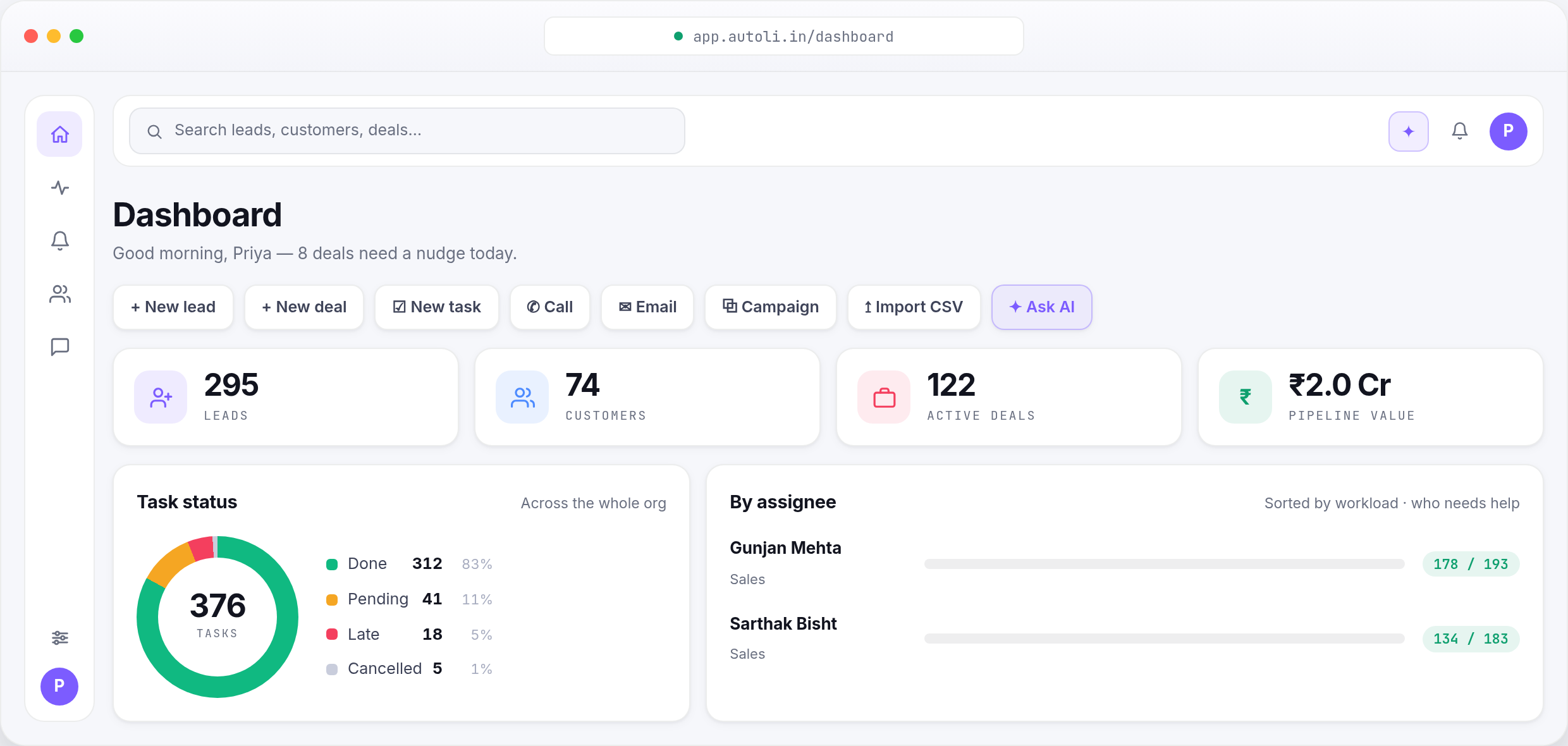
Native two-way Gmail sync means replies land on the right lead without anyone copying anything. And because the AI assistant writes into the CRM, you can say "add Priya from Infosys as a qualified lead, ₹5L deal" and stop maintaining the pipeline by hand.
Do not lose it at the invoice
You can win the speed race and still lose the deal three weeks later because your paperwork looked amateur. Branded quotations, GST invoices with gapless numbering, instalment plans, and payment reminders that go out over WhatsApp on their own. It is unglamorous and it is where a surprising number of Indian deals actually stall.
What I would actually do this week
You do not need to buy anything to start. In rough order of return:
- Measure your current response time. Not your guess at it. Take last month's inbound leads and find the real median gap between form-fill and first contact. Most teams are shocked. Do this before anything else, because it is your baseline.
- Fix routing before automation. If leads sit in a shared inbox with no owner, automating that just gets you to "nobody" faster.
- Put something on WhatsApp after hours. Even a good auto-reply that sets an expectation beats silence. An agent that qualifies is better.
- Stop letting calls go unanswered. A missed call from an unknown number, at night, is a buying signal in this market.
- Then measure again. If the number has not moved, the tool is not the problem.
The part nobody wants to hear
Automation amplifies whatever process you already have. If your qualification criteria are vague, an AI agent will produce vaguely qualified leads much faster than your team ever could. If nobody owns follow-up on day three, no amount of software invents an owner.
Speed to lead is worth fixing first because it is cheap, measurable and almost universally broken. But it is a lever, not a strategy. The teams who get the most out of this are the ones who had a clear process and simply could not staff it around the clock.
If that sounds like your team, the fastest way to judge it is to use it rather than read about it. Call the agent on +91 80353 74717, poke at the live demos, or look at what it costs — one plan, everything included, ₹700 per user per month on annual billing. No feature tiers, because I have never enjoyed being on the other side of one.